This article is for informational purposes only and does not constitute legal, financial, or tax advice. Rental data referenced is based on publicly available sources and may not reflect current market conditions at the time of reading. Always consult a qualified professional before making financial decisions related to your property.
If you own a rental property in Philadelphia, you have probably asked yourself this question at least once: how much rent should I charge in Philadelphia? Price it too high and your unit sits empty. Price it too low and you leave money on the table every single month. Either way, it costs you.
The answer is not as simple as checking Zillow or asking your neighbor. Philadelphia is not one rental market. Rents vary significantly from one neighborhood to the next, and the difference between getting it right and getting it wrong can mean thousands of dollars a year in lost income or unnecessary vacancy.
This guide walks through exactly how to figure out the right rent for your property, with real Philadelphia data, a step by step process, and the most common pricing mistakes we see landlords make.
Table of Contents
Why Getting Your Rent Price Right Matters
Setting the right rent is the single biggest factor in how well your rental property performs. It affects everything: how fast your unit fills, what kind of tenant you attract, and how much money you actually take home at the end of the year.
Here is a simple example. Say you own a two bedroom in Graduate Hospital and you list it at $2,200 a month. If a comparable unit down the street is renting for $1,995, yours might sit vacant for two or three months. That is $4,400 to $6,600 in lost rent just because you overpriced by $200 a month.
On the other hand, if you underpriced that same unit at $1,700 a month, you would fill it fast but lose $3,540 over the course of a year compared to what the market would have supported.
The goal is to land in the sweet spot where you maximize monthly income without creating unnecessary vacancy. And in Philadelphia, that sweet spot changes depending on the neighborhood, the time of year, and the condition of the unit.
How Much Rent Should I Charge? Average Rent in Philadelphia by Unit Type
As of 2026, the average rent in Philadelphia is roughly $2,022 per month across all unit types. But that citywide average does not tell you much on its own.
Here is the breakdown by unit size:
| Unit Type | Average Rent |
| Studio | $1,492 |
| 1 Bedroom | $1,849 |
| 2 Bedroom | $2,319 |
| 3 Bedroom | $3,521 |
These numbers pull from aggregated listing data across the city. They are useful as a starting point, but your property’s actual value depends on where it is, what it looks like, and what the competition is charging nearby. That is where neighborhood data and rental comps come in.
Philadelphia Rent by Neighborhood
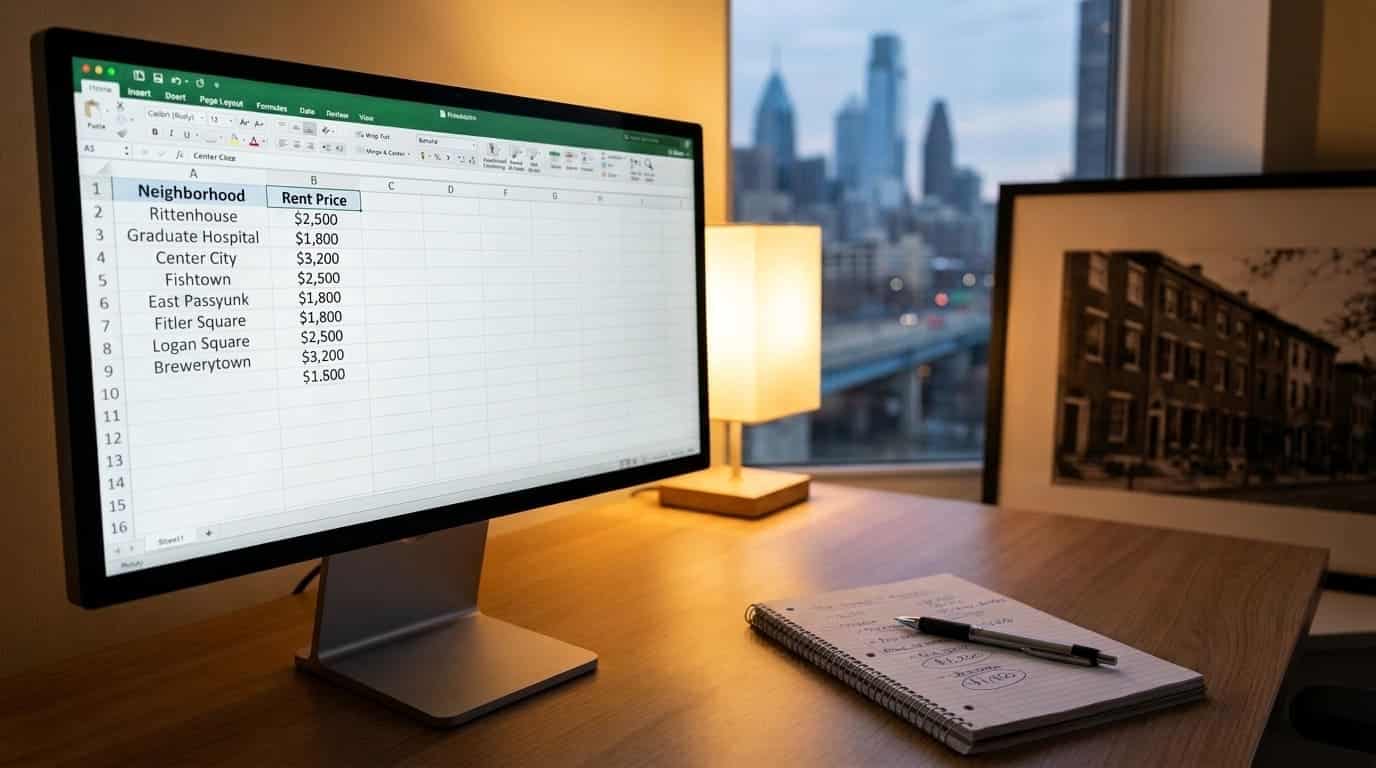
Philadelphia is a city of neighborhoods, and the rent differences between them are significant. Here is a look at median rents across the areas where most rental activity happens:
| Neighborhood | Median Rent (1BR) | Notes |
| Logan Square | $4,093 | Highest rents in the city. Newer construction drives pricing. |
| Society Hill | $3,481 | Historic area, strong demand from professionals. |
| Rittenhouse Square | $2,500 | Consistently high. Walkability and dining keep demand steady. |
| Northern Liberties | $2,400 | Popular with younger renters. Pricing has leveled off. |
| Graduate Hospital | $1,995 | Steady market. Units lease in under two weeks when priced right. |
| Fishtown | $2,200 | Strong demand but sensitive to overpricing. |
| Point Breeze | $1,500 | More affordable, attracting first time investors. |
Same city. Different dynamics. A landlord in Point Breeze and a landlord in Society Hill are operating in completely different markets, and their pricing strategies should reflect that.
If you are trying to figure out how much rent you should charge, start by looking at what similar properties are actually renting for in your specific neighborhood. Not the city average.
How to Determine Rent Price Using Rental Comps
Rental comps are the most reliable way to figure out what your property should rent for. A comp is simply a recently rented property that is similar to yours in size, location, condition, and amenities.
Here is how to run your own comp analysis:
Step 1: Find 3 to 5 recently rented properties near you.
Look on Zillow, Apartments.com, Rentometer, or the MLS if you have access. Focus on properties within a quarter mile of yours that have rented in the last 60 to 90 days. You also want to prioritize homes in the same neighborhood.
Step 2: Match on the basics.
Compare bedroom count, bathroom count, square footage, and parking. A two bedroom with in unit laundry and a parking spot is not comparable to a two bedroom walkup with street parking. Be honest about what your unit actually is.
Step 3: Adjust for differences.
If your unit has central air and the comp does not, your rent can be slightly higher. If the comp was recently renovated and yours has not been updated in ten years, adjust down. Some rough adjustment values:
| Feature | Approximate Value |
| In unit laundry | +$75 to $150/month |
| Parking spot | +$100 to $200/month |
| Central air | +$50 to $100/month |
| Recently renovated | +$100 to $250/month |
| No outdoor space | Subtract $50 to $75/month |
Step 4: Look at days on market.
If comparable units are leasing in under two weeks, the neighborhood can probably support slightly higher rents. If similar units are sitting for 45 to 60 days, pricing pressure is real and you may need to come in at or slightly below the average.
Step 5: Set your price and watch the response.
If you get 10 inquiries in the first 48 hours, you may have priced too low. If you get zero inquiries in the first week, you probably priced too high. The market will tell you quickly.
The 1% Rule: Does It Actually Work in Philadelphia?
The 1% rule is a popular shortcut in real estate investing. It says you should charge 1% of the property’s value in monthly rent. So a property worth $300,000 would rent for $3,000 a month.
In theory, it is simple. In practice, it rarely works in Philadelphia.
Here is why. In neighborhoods like Rittenhouse Square and Society Hill, property values are high but rents do not scale at the same rate. A $600,000 condo in Rittenhouse is not going to rent for $6,000 a month. The actual rent might be $2,500 to $3,000.
In more affordable neighborhoods like Point Breeze, you might actually exceed the 1% rule. A property purchased for $180,000 could realistically rent for $1,500 to $1,800 a month.
The 1% rule can be a useful gut check, but it should never be the only method you use to decide how much rent to charge. Rental comps and neighborhood data will always give you a more accurate picture.
5 Pricing Mistakes Philadelphia Landlords Make
After managing properties across Philadelphia, we see the same pricing mistakes come up again and again. Here are the five most common ones.
1. Pricing Based on Your Mortgage, Not the Market
Your mortgage payment, taxes, and insurance are your costs. They are not the market’s problem. If your monthly expenses are $2,200 but comparable units are renting for $1,800, the market does not care what you owe. Price to the market, not to your spreadsheet.
2. Ignoring Seasonal Timing
Philadelphia’s rental market has a clear seasonal pattern. Demand peaks from May through August when most leases turn over and people are actively moving. Listing in November or December usually means longer vacancy and sometimes lower rent. If you have flexibility on when to list, aim for late spring or early summer.
3. Overpricing by $100 to $200 “Just to See”
This one is tempting. You figure you will list high and negotiate down if needed. But in practice, overpriced units get skipped. Renters are searching by price filters, and if your unit is $100 above comparable listings, it may not even show up in their results. Two months of vacancy costs far more than that $100 a month you were trying to capture.
4. Underpricing to Fill Fast
Some landlords go the opposite direction. They price low to guarantee a quick fill. The unit rents in three days and they feel good about it. But if you underpriced by $150 a month on a 12 month lease, that is $1,800 in lost income over the year. Getting a tenant fast is great. Leaving $1,800 on the table is not.
5. Never Adjusting After Year One
The market moves. If you signed a lease two years ago and have not looked at comparable rents since, there is a good chance you are below market. We regularly see landlords who have not raised rent in three or four years and are $200 to $400 below what the neighborhood supports. Annual rent reviews are not optional if you want to protect your rental property roi.

When to Raise Rent and How Much
Pennsylvania does not have statewide rent control, and Philadelphia currently does not cap how much you can raise rent. That said, you still need to give proper notice. If you are unsure about your obligations as a Philadelphia landlord, our guide on how to get a Philadelphia rental license covers the legal requirements you should know.
Notice requirements:
- Leases of one year or longer: 60 days written notice
- Leases shorter than one year: 30 days written notice
How much to raise:
A good rule of thumb is to bring rent in line with current market rates using the comp analysis described above. If the market has moved up 3% to 5% since the last lease, a modest increase keeps you competitive without shocking your tenant.
Large jumps (10% or more at once) can push good tenants out, which means turnover costs, vacancy, and the risk of getting a worse tenant. Steady, annual adjustments tend to produce better long term results than big corrections every few years.
The best time to evaluate is 90 days before a lease expires. Run fresh comps, review your costs, and decide whether an increase is warranted. If your tenant is reliable and taking care of the property, keeping them at a slightly below market rate can still be the smart move.
How a Rental Income Analysis Takes the Guesswork Out
If all of this sounds like a lot of work, that is because it is. Running comps, tracking neighborhood trends, adjusting for features, and timing the market correctly takes real effort and real local knowledge. That is a big part of what a property management company does for you.
That is exactly why we offer a free Rental Income Analysis for Philadelphia property owners. We look at your specific property, pull real market data for your neighborhood, and tell you exactly what your unit should be renting for right now.
No commitment, no pressure. Just the number.
Whether you are a landlord trying to figure out how much rent you should charge on a new unit, or you have not reviewed your pricing in a few years and want to make sure you are not leaving money on the table, this is the fastest way to get a clear answer.
FAQ
How much rent should I charge for a 2 bedroom in Philadelphia?
It depends entirely on the neighborhood. As of 2026, the citywide average for a two bedroom is around $2,319 per month. But a two bedroom in Point Breeze might rent for $1,400 while the same layout in Logan Square could fetch over $3,500. Always price based on local comps, not city averages.
What is fair market rent in Philadelphia?
Fair market rent is the amount a property would reasonably rent for in the open market. In Philadelphia, fair market rent varies widely by neighborhood and unit type. The best way to determine it is through a comp analysis of recently rented properties similar to yours within a half mile radius. If you want help with that, reach out to our team and we will run the numbers for you.
How do I find rental comps for my property?
Start with Zillow, Apartments.com, and Rentometer. Filter by your neighborhood, unit size, and recent rental date (within the last 90 days). If you have MLS access, that gives you the most accurate data. Look for 3 to 5 comparable properties and adjust for differences in condition, amenities, and parking.
Can I charge whatever I want for rent in Philadelphia?
Legally, yes. Philadelphia does not have rent control and Pennsylvania does not cap rental rates. However, the market will correct you. If you price above what comparable units are renting for, your property will sit vacant. The practical limit on rent is always what the market will support.
How often should I adjust my rent price?
At minimum, review your rent once a year before each lease renewal. Run fresh comps and compare your current rate to what similar units are renting for. Small annual adjustments (3% to 5%) are easier for tenants to absorb and keep your income aligned with the market over time.

Mike Goldstein is the CEO and Broker of Record at HubKey Real Estate. He bought his first Philadelphia rental property in 2008 and has been managing and acquiring properties across the city ever since. He founded HubKey in 2022 to bring transparency to Philadelphia property management. His focus is helping everyday people build wealth through real estate.